


BEIJING, China (CNN) -- China in 1978 was stranded at a political crossroad. It was just emerging from the chaos of the Cultural Revolution and the death of Chairman Mao. Deng Xiaoping had emerged as the new leader, but Mao's dogma remained deep-rooted and seemingly immutable. In and outside the Communist Party, a debate raged: Where to, China?
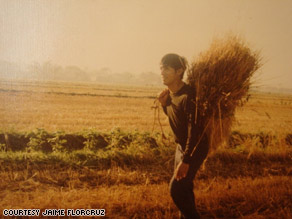
CNN Beijing Bureau Chief Jaime FlorCruz worked on a farm in China's Hunan province during the 1970s.
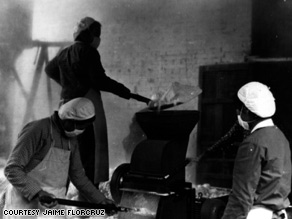
Inside a Beijing factory during the early 1970s, long before "Made in China" became the national brand.
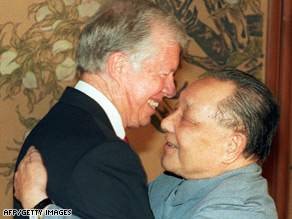
Chinese leader Deng Xiaoping embraces former U.S. President Jimmy Carter in Beijing in 1987.
-------------------------------------

On December 18, 1978, Chinese leader Deng Xiaoping gave his answer. In a Communist Party meeting in Beijing that day, the political elite adopted Deng's pragmatic program and launched economic reforms. New China was born.
People paraded in the streets to celebrate. Families gathered around the dinner table, uncorked wine bottles and toasted each other.
Thirty years hence, China's radical makeover is apparent.
China now is nothing short of an economic miracle. Its economy has grown at an average of 9.8 percent since 1978, making it the fourth largest economy in the world. Incredibly, China has pulled off the equivalent of reform, renaissance and industrial revolution in 30 years.  Watch what Deng unleashed »
It's incredible because only three decades ago China was so poor and isolated.
I saw it up close when I worked on a farm in Hunan province, Chairman Mao's hometown, not long after I first arrived in China in 1971. For several months, I worked there with a production team planting rice, picking tea leaves, feeding pigs and digging ditches. Farmers worked hard and lived Spartan lives. Once, I attended a meeting to honor model workers; they were awarded bath towels and wash basins.
Watch FlorCruz describe China's transformation since his arrival in 1971 »

No comments:
Post a Comment